

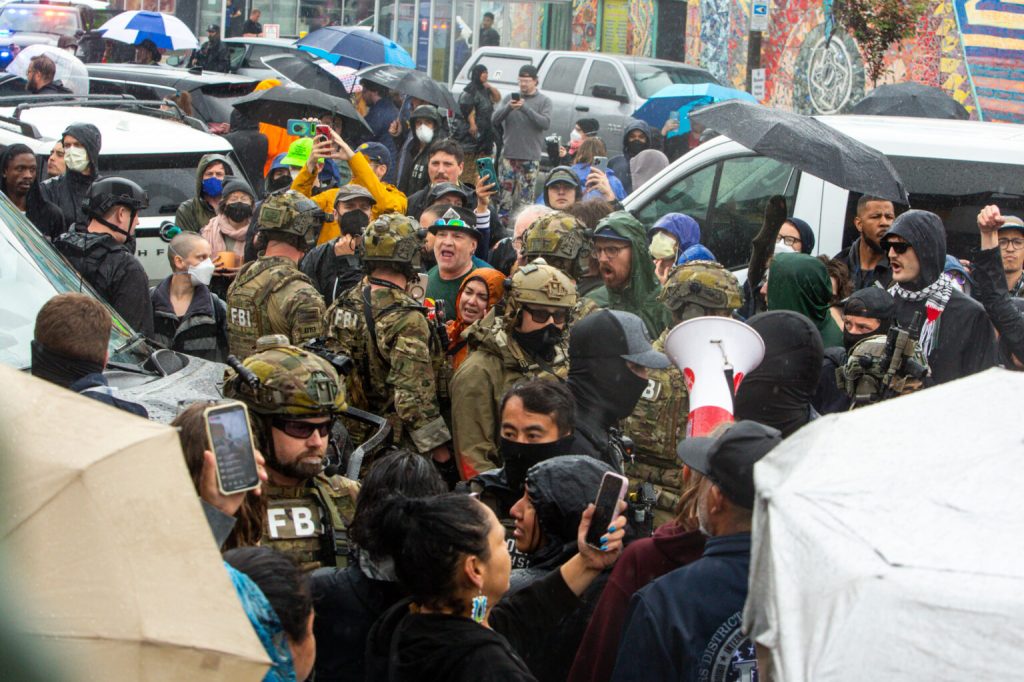
Immigration and Customs Enforcement under the current Trump administration is functioning as a political weapon: it is expanding raids, shootings, and detention while eroding due process, wrongfully deporting people with claims to U.S. citizenship, and deepening an already authoritarian, racialized system of social control. This has produced a trail of deaths in custody, killing like that of U.S. citizen Renee Good, and a mounting record of abusive deportations, often shielded from accountability by secrecy and legal loopholes.
Under Trump’s current term (which is only one year in, unfortunately), I.C.E. has deployed not just as an immigration agency but at a force multiplier in a broader “law and order” crackdown, including large federal deployments into cities like Minneapolis and New York under operation justified by alleged fraud or crime in immigrant communities, that’s looking a lot less like immigration enforcement and more like state-sponsored domestic terrorism.
Trump’s Department of Homeland Security leadership, including the infamous corrupt Secretary Kristi Noem, has framed aggressive enforcement as a response to “domestic terrorism” by immigrants and even by observers, giving political cover to violent tactics on the ground.
This escalated posture has coincided with an increased I.C.E. presence in heavily Black, brown, and immigrant neighborhoods and communities, creating an atmosphere where residents describe feeling “terrorized” by constant raids and armed teams in the streets. Federal surge operation such as those around welfare-fraud allegations in the Somali community in Minnesota, turn entire communities into suspects, blurring any line between targeted enforcement and collective punishment.
Deaths, shootings, and killings
I.C.E. detention and enforcement under this administration are deadly, not just harsh, and a blatant and obvious disregard of civil liberties and human life. At least 32 people died in I.C.E. jails in 2025 alone, and several more have already died in 2026, reflecting a system where overcrowding, medical neglect, and mental distress are routine, not exceptional. Long-term data show a steady toll of deaths in custody over the last decade, with people dying from treatable conditions, suicide, and inadequate care in facilities that are officially “civil” but operate like punitive prisons.
Outside the walls, I.C.E. agents have opened fire repeatedly during deportation operations, completely disregarding the printed I.C.E handbook and customs that federal law enforcement are supposed to follow during arrests to stay lawful and civil. By early January 2026, agents had fired on people at least nine times across five states and Washington, D.C., since September 2025, killing at least four other people besides Renne Good. Each shooting is justified by claims of self-defense (mind you, these are regular citizens who do not have nearly as much protection or weapons that these agents are so “scared” of), but the pattern, armed agents repeatedly using lethal force while on offensives in civilian neighborhoods, looks far closer to militarized occupation than to proportional civil enforcement.
Renee Good (may she rest easy)

Renee Good was a 37-year-old U.S. citizen, a mother of three, who loved to sing and write poetry and lived in Minneapolis. On January 7, 2026, she was fatally shot by I.C.E. agent Jonathan Ross after she drove near a cluster of I.C.E. vehicles during a period of intensified enforcement in the city.
DHS Secretary Kristi Noem immediately claimed that Good tried to “weaponize her vehicle” and commit” an act of domestic terrorism’ by attempting to run over officers, language that casts a citizen mother as a terrorist and frames the killing as a righteous act of war. State officials, including Minnesota Attorney General Keith Ellison and Representative Ilhan Omar, rejected that narrative, with journalists pointing out that the video of the shooting contradicts claims that she was trying to ram agents, and community members describing weeks of I.C.E. presence as “terrorizing.”
Wrongful deportations of U.S. citizens
Even though I.C.E. policy acknowledges that the agency has no authority to detain or deport U.S. citizens, multiple documented cases show I.C.E. arresting, jailing, and in some instances deporting people who have valid citizenship claims. Congressional letters note that the agency has even deported U.S. citizen children alongside their undocumented parents against the families’ wishes, and advocacy research suggests that dozens of U.S. citizens may have been deported in recent years, with many more wrongfully detained.
One recent case under this administration is Chanthila Souvannarath, who derived U.S. citizenship as a child when his father naturalized and obtained sole custody, meeting all legal requirements for citizenship. In 2025, I.C.E. detained him at the notorious Angola I.C.E. facility in Louisiana and then citizenship claim and explicitly barred his removal, an act civil rights lawyers described as a “catastrophic failure” and a “flagrant violation” of constitutional rights.
Another emblematic case is that of Davino Watson, a U.S. citizen held in immigration detention for three years, forced to prove his citizenship without a lawyer, only to later be denied any compensation because the statute of limitations had expired by the time he won recognition of his rights. These cases are not glitches; they reveal a system where the presumption of non-citizenship is so strong for certain racialized people that even clear legal evidence and court orders are ignored.
Due process erosion and an authoritarian drift
The combination of lethal force, wrongful deportations, and mass detention works by hollowing out due process protections that are supposed to apply to “persons” in the United States, not just citizens. Members of Congress have documented that I.C.E. has detained U.S. citizens for over a week, used violent force during erroneous arrests, and deported people with serious ongoing litigation, all while the system provides no guaranteed counsel for people in detention. This pattern turns immigration jails into spaces where constitutional rights are “theoretical” but not meaningfully enforceable, because the people inside are isolated, poor, and often denied lawyers.
At the same time, the administration’s rhetoric, labeling a killed citizen “domestic terrorism” while announcing new national enforcement like “Operation Salvo” days after her death, normalizes the idea that federal police can treat everyday life in immigrant neighborhoods as a battlefield. That is what pushes the country toward an authoritarian dystopia: a government that increasingly reserves full legal personhood, safety, and credibility for some, while treating others as disposable threats whose deaths, trauma, and exile are politically acceptable collateral.
Deporting 5-year-old Liam Conejo Ramos
Five-year-old Liam Conjeo Ramos’ case shows how I.C.E.’s current crackdown is willing to traumatize children who have done nothing wrong to make a political point about “enforcement.” He and his father, asylum seekers from Ecudaor with an active case and no deportation order, were seized outside their Minneapolis-area home after Liam returned from preschool, then taken to a family detention facility in Texas.
According to school officials and the family’s lawyer, armed agents pulled Liam from a still-running car, refused pleas from another adult to care for him, and walked him to the front door to knock so they could see who else was inside, effectively using a terrified five-year-old as bait in a raid on his own home. The Department of Homeland Security publicly insisted the child had been “abandoned” and denied targeting him, but that spin collapses against eyewitnesses accounts, photographs of a small boy in a winter hat and backpack surrounded by masked agents, and the undisputed fact that there was no deportation order or alleged criminal conduct to justify tearing him from his community and caging him hundreds of miles away.
This is a developing story and is subject to update.



 they, them, and then some
Leave a comment