

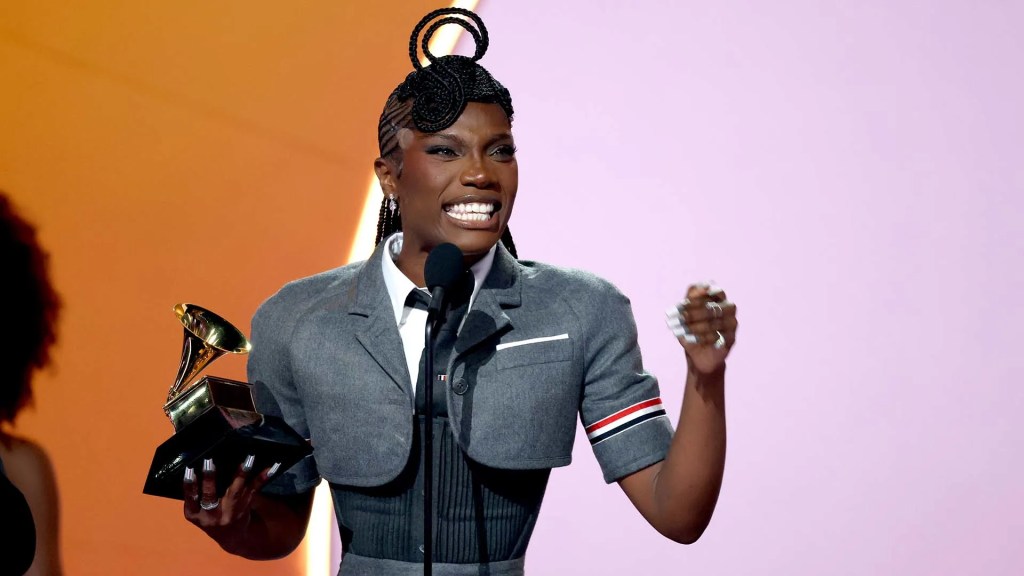
Tampa-born rapper, singer, and GRAMMY winner Doechii has become one of music’s most compelling and conversation-starting new voices. Her major-label journey, however, exemplifies the uniquely harsh gauntlet Black women artists, particularly dark-skinned Black women, are forced to run. The release of her new single “girl, get up,” a collaboration with superstar SZA, is not just a musical moment; it’s a point of resilience in a career already marked by intense public scrutiny, accusations of inauthenticity, and the pervasive poison of misogynoir.
Doechii, signed to Top Dawg Entertainment and Capitol Records, burst into wider consciousness with the viral sensation of “Yucky Blucky Fruitcake” and the critical acclaim of her 2024 Mixtape, Alligator Bites Never Heal. Yet, a pivotal moment of fan interaction sparked a cycle of criticism that would follow her. For months, fans online begged her to release a song snippet they called “Anxiety.” When she finally released the polished, official version in 2023, a segment of her audience turned. They trashed the production, criticized her vocals, and accused her of ruining the “raw” sound they loved (whatever that means). The narrative quickly morphed from eager anticipation to a wholesale slandering of her artistic choices.
This incident became a cornerstone for a growing, toxic allegation: that Doechii is an “industry plant.” The term, used to discredit an artist’s organic rise by implying secret industry manipulation, is often weaponized disproportionately against Black artists, specifically Black women artists. The logic is circular and cruel: her success is proof of the plot, and any misstep or evolution is evidence of its failure.
Doechii directly addresses the weight of these expectations and the specific intersection of racism and sexism she faces on her rise to popularity and through her experiences of being a Black woman in the industry. On the track “girl, get up,” she raps, “Life is but a dream for a dark skin bitch like me / Life gets dark when you’re dark like me.” She articulated the impossible tightrope walk of existing in an industry with narrow, often colorist, standards for dark skinned Black women’s marketability and authenticity.
The “industry plant” accusation has been amplified by prominent voices in digital spaces. Streamers like XQC, Adin Ross, and Stable Ronaldo (shocker, all white individuals) have dedicated entire segments, songs, and social media posts dissecting, dismissing, and often violently, harshly, and aggressively slandering her name and career trajectory, using the “plant” framework to millions of viewers. The day she hires Megan’s lawyers is the day a lesson will be taught. Music blogs and press outlets have fueled the discourse, frequently framing stories around the controversy rather than her music or message. This creates an environment where her art is secondary to a manufactured debate about her legitimacy, a classic manifestation of misogynoir – the specific anti-Black, misogynistic prejudice faced by Black women.
Enter “girl, get up.” The SZA-assisted track is a synth-driven, brash anthem of self-affirmation. Its title, a direct command to rise, feels meta. Over a booming bass, Doechii declares, “I don’t read y’all tweets, I delete y’all threads / Don’t need weed to be ten feet tall / I don’t need keys when I knock down walls.” SZA’s feathery chorus reinforces the theme: “Pickin’ on non-confrontation / Fuck a limitation, leave me girl, get up.” The collaboration itself is a powerful rebuttal, showcasing solidarity between two Black women artists at different career peaks. It is a sonic middle finger to the noise, an assertion of presence that refuses to be bogged down by external accusations.
It kind of reminds me of when Megan Thee Stallion had to drop her hit number one single “HISS” because y’all couldn’t keep her out of y’all mouths. It’s almost like we love bothering successful darkskin Black women.
The path for dark-skinned Black women in hip-hop and pop has never been clear of fair. They are scrutinized for their aesthetics, policed on their authenticity, and subjected to a credibility test that their peers often bypass. Doechii’s experience – from the “Anxiety” backlash to the relentless “plant” allegations amplified by streamers and digital media – is a textbook case study in this dynamic.
“girl, get up” is more than a song. It is Doechii’s strategy, rhythmic clapback (and a little sneak peek into what we’ll see on the album). She is choosing, audibly, to rise above the fray, leveraging her platform and her partnership with an artist like SZA to redefine the narrative on her own terms. The industry may plant seeds, but Doechii is making it unequivocally clear that she is the one growing, wildly and unapologetically, into a force they will have to reckon with. The command isn’t just in the lyrics; it’s the statement for her entire, unfolding career. Girl, she’s up.

 they, them, and then some
Leave a comment